Thursday, November 4, 2021

Sharing Something Beautiful (Friday Devotional)


And what you have heard from me in the presence of many witnesses entrust to faithful men who will be able to teach others also.

- 2 Timothy 2:2

In his lifetime, writer Franz Kafka published only a few short stories and articles. While known in literary circles in his native Prague, he was nowhere close to a household name, and in fact made his living as an insurance officer, writing only in his spare time.

So when he contracted tuberculosis in his 30s and made out his will, it was with a spirit of discouragement that he instructed his friend and executor, Max Brod, to burn all of his unpublished works—from unfinished novels to letters to diaries. But upon Kafka’s death, Brod ignored the instructions to burn without reading, and what he found amazed him. He was convinced that Kafka’s wishes could not be fulfilled, that to do so would starve the world of something beautiful. Kafka today is acknowledged as one of the greatest writers to ever live—but only because Brod shared what he’d read.

The gospel is like that too—for it to make a difference in our world, it needs to be shared. God has given us the good news of salvation through His Son, but not as a secret to be kept or a treasure to be hoarded. The task of God’s people is to tell others about Jesus, to use both our words and deeds to bear witness to the grace of God in Christ.

When the gospel is shared far and wide, the world is changed for the better—but first it must be shared. How will you share the good news today?

Monday, November 1, 2021

October Reading Log

3 books this month, which made for plenty of reading but not a very long reading log. Nevertheless, there was plenty to think about and write about. Take a look!

4 Articles I Like This Month

"Integrity and the Future of the Church" by Russell Moore, Plough. 17 minutes.

A sobering, insightful look at what is driving so-called "ex-vangelicals" to leave the church...it's not them, it's us.

"The Passion of Questlove" by Jazmine Hughes, The New York Times Magazine. 24 minutes.

A profile of the always fascinating D.J., audiophile, and frontman for the Roots.

"I Had a Chance to Travel Anywhere. Why Did I Pick Spokane?" by Jon Mooallem, The New York Times Magazine. 22 minutes.

The author, prepared to enter post-pandemic life, attended a minor league baseball game. What did her learn from the experience about America?

"The Afterlife of Rachel Held Evans" by Eliza Griswold, The New Yorker. 17 minutes.

A profile of one of my favorite Christian writers, the late Rachel Held Evans, in preparation of the release of her posthumous memoir.

Reading Through the Fantastic Four- #175-193, Annual #12

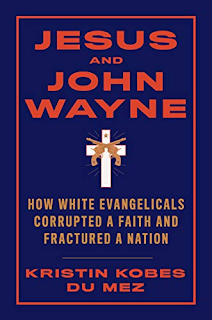
JESUS AND JOHN WAYNE: HOW WHITE EVANGELICALS CORRUPTED A FAITH AND FRACTURED A NATION by Kristin Kobes du Mez

Many have remarked in the last 5 years that American evangelicalism seems to be more of a sociopolitical movement than a religious one, more grounded in subculture than theology. Articles, blog posts, speeches, and endless pontificating by pundits have decried how different the American evangelical church looks from the one Jesus established in the first century. But few have told the story of how this came to be. Jesus and John Wayne, a seminal work by history professor Kristen Kobes du Mez, tells that story persuasively and powerfully.

According to du Mez, American evangelism emerged as a mixture of biblical theology, Christian nationalism, southern heritage, and masculine militancy, and can trace its birth to the early days of the Cold War. It was in that time, with the looming threat of Communism top of mind, that American Christians, insecure in the face of a changing world, began looking for security in the kind of men exemplified by the characters played by John Wayne: rugged defenders of law and order. None of that is particularly novel—people have always turned to strongmen in times of fear. What was new was the way the church began to gradually baptize this archetype.

Moving chronologically from Billy Graham to Jerry Falwell to Oliver North to the cast of Duck Dynasty to, finally, Donald Trump, du Mez convincingly shows how key figures came to exemplify (some intentionally, some unwittingly) this movement and how, by 2016, being an "evangelical" had come to mean something much different from "Bible believing Christian" even as most evangelicals maintained they were synonyms.

Ultimately, du Mez postulates, what today drives American evangelicalism as we know it is fear—fear of change, fear of being reduced or replaced, fear of an unknown future. What's left to the next generation, if we are to turn the ship around, is to remind people that perfect love casts out fear. As du Mez puts it in the book's final sentences, "Appreciating how this ideology developed over time is also essential for those who wish to dismantle it. What was once done might also be undone."


MIDDLESEX by Jeffrey Eugenides

Hooooo boy. Going to have to be careful how I write this review.

That's because Middlesex, the winner of the 2003 Pulitzer Prize for Fiction, is a coming-of-age novel about a hermaphrodite, a.k.a. an intersex individual, someone who is born with both characteristics of both sexes and cannot be classified in a binary sense. Dealing with issues of sex and gender, the book is ahead of its time in many ways (though, for those deeply enmeshed in the LGBTQ+ community, I suspect it is considered retrograde in other senses). And for those almost totally unfamiliar with these topics <raises hand timidly> it is an education and, like all great novels, an exercise in empathy.

But, as you might guess about an award-winning novel, it is not confined to one topic. In fact, the book is equal parts family saga, immigrant novel, and coming-of-age story, while also having a good deal to say about America (specifically Detroit) in the 1950s through 1970s. To be more specific, it tells the story of Cal (initially Calliope) Stephanides and her struggle growing up with the secret, suspected but not entirely understood, that she is intersex. As Cal tells his story, he takes it all the way back to the scandalous marriage of his grandparents in Greece and their immigration to America, as well as the meeting and marriage of his parents and ultimately Cal's own birth.

Throughout the book, several themes dominate: shame, acceptance, and ultimately, redemption. By telling his family's story, Cal comes to terms with his own; by grounding his identity in his family story, he is able to make sense out of the confusion he was born into.

Jeffrey Eugenides is a masterful writer (this was my second of his novels, and far superior to the other, The Marriage Plot), and manages to pull off the literary feat of telling a complex, thematic story without ever seeming pretentious or overly intellectual. While the plot of this book is worlds away from what I'd normally read, his engaging prose and relatable characters hooked me early. For those willing to listen and learn, to put yourself in the shoes of someone whose experience you know nothing about, I recommend Middlesex. It'll stretch you, to be sure. But sometimes we need that.


ESSENTIAL GHOST RIDER VOL. 1 by Various

My impression going into this Essential volume, the first of four on this character, was that Ghost Rider is a fantastic design in search of a character. After reading his first 20+ issues, I stand by that assessment.

There is no doubt, Ghost Rider looks cool. I mean, look at that image above. A leather-bedecked motorcycle rider with a flaming skull for a head?  That's just awesome, especially when his cycle has flaming wheels (not pictured above, but quickly made a feature of the character.) It's for good reason that Ghost Rider's design has barely changed at all in the 40+ years since his introduction.

But as for the character and his stories, this volume shows that Marvel knew they had visual gold long before they had any narrative to match. While the origin would later be retconned more than once, Ghost Rider's basic origin comes down to a deal with the devil, a deal struck by stunt rider Johnny Blaze (yep, that's his real name) in order to save his mentor and the father of his girlfriend. In exchange for the sparing of that life, Blaze becomes an agent of darkness, transformed every night (and then in a later retcon, whenever danger lurks) into a hellfire-wielding demon.

It's actually not the worst premise, just one that never really goes anywhere, at least not in this volume. As depicted by a rotating cast of Marvel's Bronze Age writers, Ghost Rider is little more than an Evil Kinevil ripoff, an undisguised attempt by Marvel to cash in on that 1970s craze. The character doesn't acquire any memorable villains in his first few years, his support cast is so boring that he ends up stealing someone from Daredevil's (Karen Page briefly joins Blaze's stunt crew), and the character as a whole feels utterly directionless. For a character who looks so dynamic, it's amazing how boring his book really is.

Ghost Rider's early stories betray the danger of when comics rush something out. With a design like Ghost Rider's on the cover, comic readers were always going to give this book a shot. But if I'd been there in the 1970s, it wouldn't have taken me long to give up on the book. Great visuals will get you started in comics, but they can't be the only thing you have going for you.

Friday, October 29, 2021

Learning the Notes (Friday Devotional)


Therefore let us move beyond the elementary teachings about Christ and be taken forward to maturity, not laying again the foundation of repentance from acts that lead to death, and of faith in God.

- Hebrews 6:1

In high school, after working my way through the catalogues of musicians like B.B. King, Bob Dylan, and Bruce Springsteen, I made a snap decision: I was going to learn to play the harmonica. I loved its bluesie sound, its humble roots, and, not incidentally, how much cheaper it was than an electric guitar. And, maybe because of its size, I had a sneaking suspicion it was an easier instrument to learn than those my friends lugged around for marching band. With a few minutes of practice per day, I was convinced I’d be joining a blues group in no time.

So with a cheap harmonica in hand, I headed out to our garage, where the sounds of my practicing wouldn’t disturb anyone, put my lips to the metal, and blew. I went at it for somewhere between 5 and 10 minutes, trying to get a feel for the instrument, before finally scowling and returning to my bedroom, the harmonica abandoned on top of the garage fridge. It turns out, the harmonica was just like any other instrument—learning it was going to take time, effort, and patience.

Life in Christ, it turns out, is a lot like learning the harmonica. The mistaken impression many have upon believing Jesus is Lord is that you’ve got it all figured out, that all that remains to be done is to apply what you know and tell others about it. The gospel, after all, is simple enough, right?

But the truth is that, while the gospel is easy to understand, accept, and explain, life is not—and so life in Christ winds up being more a journey of sanctification than just a moment of salvation. For all the joys of those early days of faith, there are even greater joys to be found in maturity, when you’ve better learned to connect the timeless truths of doctrine with the varying situations of experience.

Walking with Christ is a lifetime commitment, one that requires not only the passion and excitement of conversion, but also the patience and wisdom of sanctification. It takes time to learn the notes—but practice makes perfect.

Thursday, October 21, 2021

Subtle Change (Friday Devotional)


Do you not know that wrongdoers will not inherit the kingdom of God? Do not be deceived! Fornicators, idolaters, adulterers, male prostitutes, sodomites, thieves, the greedy, drunkards, revilers, robbers—none of these will inherit the kingdom of God. And this is what some of you used to be. But you were washed, you were sanctified, you were justified in the name of the Lord Jesus Christ and in the Spirit of our God.

- 1 Corinthians 6:9-11

Once I was boiling a pot of water on a stove that I suspected wasn’t working properly. The pot had been sitting on the burner for several minutes and there were no bubbles, no steam, no indication that the water was even warm, much less near boiling. So I absentmindedly did the dumbest thing I could have done—I stuck my finger in the water to test its temperature.

Yeah. I know.

As you might have guessed, the stove was working just fine, and the water was scalding hot. Despite the appearance that nothing was happening, the water had been changing, slowly rising in temperature, the entire time.

Sanctification, your spiritual cleansing in Christ, can be as subtle as that water’s boiling process. When you become a believer in Jesus, your newfound faith comes with a repentant commitment to a new way of life. You’re prepared to throw aside the sins that once ruled you and turn things over to your Lord, to be completely transformed.

But as time goes by, Satan begins to tell you a devious lie: you’re exactly who you always were. Pairing temptation with guilt and shame, he works to convince you that your relationship with Christ hasn’t changed you at all, that you’re just as weak and worthless as you ever were, unworthy of God’s attention, much less his love.

But the Bible reminds us that, just like the water on my stove, anyone who professes faith in Jesus is unquestionably changed. Once fallen, in Christ you are called faithful. Once wretched, in Christ you are declared righteous. Once a sinner, in Christ you are a saint.

Faith is a journey, something with ups and downs, successes and failures. You will inevitably stumble, only to repent and receive forgiveness by the grace of God. But never make the mistake of thinking you’re exactly who you were before you knew Jesus. The truth is as gracious as it is glorious: you are a new creation.

Thursday, October 14, 2021

What's On Your Mind? (Friday Devotional)


Since, then, you have been raised with Christ, set your hearts on things above, where Christ is, seated at the right hand of God. Set your minds on things above, not on earthly things. For you died, and your life is now hidden with Christ in God.

Colossians 3:1-3

There are certain things in life I just don’t think about much, if at all. For example, I haven’t thought about trigonometry since high school. I don’t spend a lot of time pondering Nigerian politics. My mind rarely turns to thoughts of Major League Lacrosse. It’s not necessarily that these things are unimportant—they just don’t have any relevance to me.

Then there are those things I think about at certain designated moments of the day. For example, I think about current events when I open the newspaper every morning, then largely move on to other things once I’ve finished reading. I think about whatever TV show I’m watching while I’m watching it, but don’t do much reflecting on it afterwards. I focus on my morning run while I’m running, but not again until the next morning. These are all things worthy of my attention, but only for a few chosen moments of the day.

And finally, there are those things which are such a part of my being, so omnipresent in my life, that they never fully leave my thoughts. My dreams. My kids. My wife. They are, as the song says, always on my mind.

The Bible is clear that we are called to set our minds on the things of God, to turn our attention to what is holy, to fix our eyes on Jesus. So the question is simple: when are you thinking about the Lord? Rarely? Occasionally? Or always?

Is God on your mind today?

Friday, October 8, 2021

More Than a Sample (Friday Devotional)


And I pray that you, being rooted and established in love, may have power, together with all the Lord’s holy people, to grasp how wide and long and high and deep is the love of Christ, and to know this love that surpasses knowledge—that you may be filled to the measure of all the fullness of God.

- Ephesians 3:17-19

One of the annoying effects of the pandemic has been the loss of free samples at the grocery store. Pre-COVID, one of the best things about any trip to Kroger or Tom Thumb (one of the few things that made such trips more tolerable on busy shopping days) was stopping by a manned display and seeing what free food they had to offer.

Sometimes the sample is a piece of cheese on a toothpick, other times some salsa in a plastic ramekin—if you’re lucky, occasionally they may even pass out something heartier like a meatball. But these free samples serve a distinct purpose for the store besides making customers a little happier while they shop. Samples offer shoppers a free taste so that they will then pony up their money for more. After all, man cannot live on free samples alone—if you want to make a meal out of what they’re offering, you’ll have to pay the price.

There is a deeply rooted misconception in our world that God’s love is given to us the way a free sample is—not as a true gift, but as a means to get you to pay up. Our insecurities and fear tell us that God’s grace is limited, that He loves us only to a certain point. Maybe He loves certain people more—“super Christians” who never seem to make any mistakes—but surely not me.

This could not be further from the truth, which is that while we were still sinners, Christ died for us. His love is not a means to an end, but is the end in and of itself—God sent His Son as an act of grace, an undeserved gift of salvation. God doesn’t love you up to a certain point. He loves you, full stop.

In a world where affection must so often be earned, where you are having to constantly prove yourself, there is something so reassuring—so gracious—about how deeply our Father loves His children. God’s love is no free sample—it’s a feast that will sustain you for eternity.

Friday, October 1, 2021

September Reading Log


I had a weird 10-day stretch this month where between busyness and laziness, I did very little reading. But in the 20 days that remained, I managed to knock a few things out. Take a look!

2 Articles I Like This Month

"The Last American Man" by Elizabeth Gilbert, GQ. 28 minutes.

A profile of Eustace Conway, a modern-day frontiersman who's equal parts Daniel Boone, Henry David Thoreau, and Davy Crockett. If you've ever wondered what it would be like to live off the land, read this story.

"My Time with Kurt Cobain" by Michael Azerrad, The New Yorker. 30 minutes.

A personal account of a former Rolling Stone journalist's relationship with Kurt Cobain. A fascinating profile of a fascinating figure in rock history.

Reading Through the Fantastic Four- #154-174, Giant-Sized FF #4-5

Ok, this is where the Bronze Age got fun. With Roy Thomas back on board as writer and artists from Don Perlin to John Buscema to an up-and-coming legend named George Pérez, this stretch of issues really embraces comics' ability to get wacky. You want a Silver Surfer ripoff named Gaard wielding a cosmic hockey stick? He's here. You want to see a golden gorilla in knight's armor jousting? Here's here too.

After the realism of the Gerry Conway stories (especially Reed and Sue's separation), which were compelling but kind of a drag, the zaniness of these stories is a delight. Thomas wastes no time getting the original band back together, casting Medusa aside so Sue can rejoin the family and putting Johnny back in his original blue costume. From there they encounter new villains and old (including some Easter eggs no one was exactly clamoring for) and save the world again and again.

In terms of ongoing, soap operatic elements, the two biggest both deal with a loss of powers. The first comes when the Thing is miraculously returned to human form, but able to remain on the team courtesy of a super-strong exoskeleton designed for him by Reed. Most issues you forget about the development altogether thanks to the suit's design (it looks exactly like the Thing's old rocky body), but it's an important change nevertheless. The other remains an ongoing plot point as of issue #174; Reed is slowly losing his ability to stretch for reasons that remain unexplained. Tune in next month to see how that gets resolved (if I remember to provide an update!)

All in all, these are comics that don't take themselves too seriously but aren't pressing for laughs either. Fun, imaginative storytelling with familiar characters—you can't ask for much more!


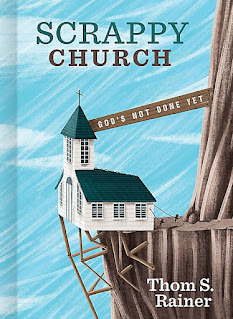
SCRAPPY CHURCH: GOD'S NOT DONE YET by Thom S. Rainer

This is not the first Thom Rainer book I've reviewed here—or the second, or the third, or the fourth. When I'm wanting some ideas, some motivation, and some insight regarding church growth, he's typically my first source. But as I've pointed out previously, the more you read of Rainer, the more you realize he's essentially recycling the same few points again and again.

Scrappy Church is no exception. If you've read Simple Church, Breakout Churches, Autopsy of a Dead Church, and the like, then you know what he has to say here. Churches need to focus outward rather than inward. They need to look for tangible ways to be welcoming to guests—improved signage, a welcome team, flyers and even gifts for guests, etc. Churches need to get out in their communities instead of waiting for their communities to come to them.

It's all the same stuff in Scrappy Church that you've read before. What makes this a good book for skimming (or reading word-for-word if it's your first exposure to Rainer) is its emphasis on following his advice without needing hundreds of members or a million dollar budget. Given that Rainer often seems to presume churches have those resources, and that this is a criticism I've leveled at him in the past, I was interested to read some of his ideas on growing the church without breaking the bank.

The book offers a few helpful anecdotes in that vein, but ultimately falls short of its intended purpose, relying mostly on vague principles rather than concrete action plans. It's a good conversation starter, but not much of a reference text. So if you like Thom Rainer, you know exactly what to expect here—just don't expect anything new.


KADDISH AND OTHER POEMS by Allen Ginsberg

Do you remember the first time you heard the Beatles’ “Come Together?” The song is basically a collection of nonsense phrases, from “toejam football” to “joo joo eyeball,” yet when you put it all together you can’t shake the feeling that there’s something going on in all that nonsense, that maybe if you listen again you’ll crack the code.

That’s essentially what it feels like to read the poems in Allen Ginsberg’s Kaddish, his second-most-notable poetry collection after Howl. Chock full of free verse and provocation, the poems range from clever to indecipherable for the uninitiated (like me)—but through it all, you never get bored, and you always feel like there’s something going on beneath the surface.

Most memorable in the collection is the titular “Kaddish,” a biographical, 50+ page ode to Ginsberg’s mother, who struggled all her life with mental health issues, including psychotic episodes. Intensely personal, the poem is a reflection on death, mourning, and estrangement, and is both painful and moving to read. It’s not an easy read (none of the poems in Kaddish are), but it’s certainly the simplest to interpret, and is considered by some scholars to be Ginsberg’s best work.

I’m not really a poetry guy, and this book didn’t change that, but it was a challenging, fascinating read nevertheless. If you’re interested in poetry generally or the Beats in particular, you’re welcome to borrow my copy.


THE END OF THE END OF THE EARTH by Jonathan Franzen

As a novelist, Jonathan Franzen is a contender for America's greatest living writer. Freedom is one of the best novels I've ever read, and The Corrections is, in the judgment of many, equally masterful. I eagerly await the arrival of Crossroads, the first in an upcoming trilogy of novels, which comes out October 5. There are few literary novelists who manage to combine big ideas, deep insights, and beautiful prose quite like Franzen.

Unfortunately, as an essayist he leaves something to be desired. While his deftness with the English language remains as impressive as ever, the missives in The End of the End of the Earth failed to connect with me, and ended up less of a treat than a homework assignment.

The primary issue is his subject matter, which, in roughly half the essays, is his love of birding. Franzen is not shy about his deep love for the hobby, and readers of The End of the End of the Earth get more than their fill of plumage descriptions and listings of species. In the best cases, like in "Save What You Love," birding is a launching point for a bigger argument, such as that essay's case that, in the wake of climate change's overwhelming danger, something as seemingly insignificant as conserving bird habitats is not only valuable, but more useful and more ethical than he oft-cited advice to buy better lightbulbs and more fuel-efficient cars. But too often, the essays in this book seem like prose versions of the lists he keeps of birds he's seen, merely narrative accounts of birding expeditions. Some may be captivated enough by his writing to enjoy that; I found it tiresome.

The secondary issue with Franzen's nonfiction is the remove from which he writes. As a novelist, he has a gift for putting you in the mind of his characters, for establishing a point of view that you understand whether you like the characters or not. But as an essayist, the infamously prickly Franzen has to say what he thinks, and the perspective, try as he does to ground himself in his Midwestern everyman-ness, is of a literary snob. Franzen is a left-winger who is apologetic about it, an elitist who wants to pretend otherwise, a member of the literati who seems uncomfortable with that undeniable fact. The result is a frustrating, not particularly likeable narrator, one whose melancholy feels more annoying than deep.

I remain thrilled to read Crossroads as soon as I get my hands on a copy, as well as any other work of fiction Franzen puts in front of me. But the next time an essay of Franzen's drops in The New Yorker or The Paris Review, my inevitable reading of it will be more out of a sense of obligation than joy. Franzen is a brilliant novelist, but his batting average on essays is too low for him to be in my lineup.


THE JOY OF KEEPING SCORE by Paul Dickson

When I was really getting into baseball as an 8-year-old, one of the things my dad taught me was the basic rules of how to keep score. Showing me both the standard notations and giving me room to make up my own, he was introducing me to a side of baseball nerd-dom I would never leave. Since that time, not only have I filled up a scorebook, I have created my own.

So The Joy of Keeping Score, a slim, photo-heavy history of the practice, was right up my alley. Containing everything from a glossary of scorekeeping symbols to evidence of the earliest scorecards, it tells you just about everything you ever wanted to know about baseball scorekeeping, and all in 100 pages. For a baseball fan mourning the oncoming end of the regular season, it was a nice September tonic.

Paul Dickson, a popular baseball historian, has done fans a real service with this book. If you've ever used the tear-out scorecard in your program, this book will give you a better idea what to do with it.


ESSENTIAL HUMAN TORCH VOL. 1 by Stan Lee, Jack Kirby, Dick Ayers, et al.

The early 1960s was a period of transition for the company that would soon be known as Marvel Comics. While Stan Lee, Jack Kirby, Steve Ditko and company were starting to introduce the world to dynamic new characters like the Fantastic Four, Spider-Man, and the Avengers, they were still figuring out their style. The company hadn’t yet fully developed its ethos, something that would be well established by the end of the decade. So those comics of the early 1960s remained largely kids fare: simple, self-contained, unchallenging stories of good guys, bad guys, and hijinks, largely indistinguishable from the output of the Distinguished Competition.

In that respect, the comics found in Essential Human Torch are very much of their time. The book collects every one of the Torch’s solo adventures in Strange Tales, where the teenage hero was afforded the opportunity to have adventures away from his teammates in the Fantastic Four (at least until the end of the run, when he began teaming up with the Thing regularly.) Every story is largely the same—the Torch is confronted by an unthreatening crook in a costume, uses some combination of his powers and his wits to foil the villain, and gets home in time to make up with his girlfriend, Dorrie Evans. The stories have the easy familiarity and simple structure of a syndicated sitcom, and are about that level of fun—nothing worth saving, but a pleasant way to spend half an hour.

By 1963, Marvel was ready to move on, convinced that Peter Parker, not Johnny Storm, was the teenage superhero worth placing their bets on. Johnny remains an iconic member of the Fantastic Four, but no serious attempt has been made since to give him a long-term solo title. Some guys just work better on a team than flying solo.